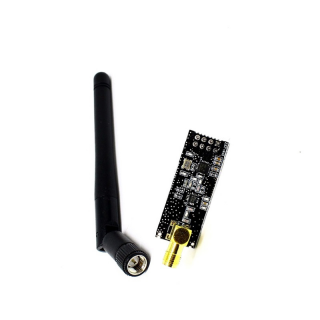
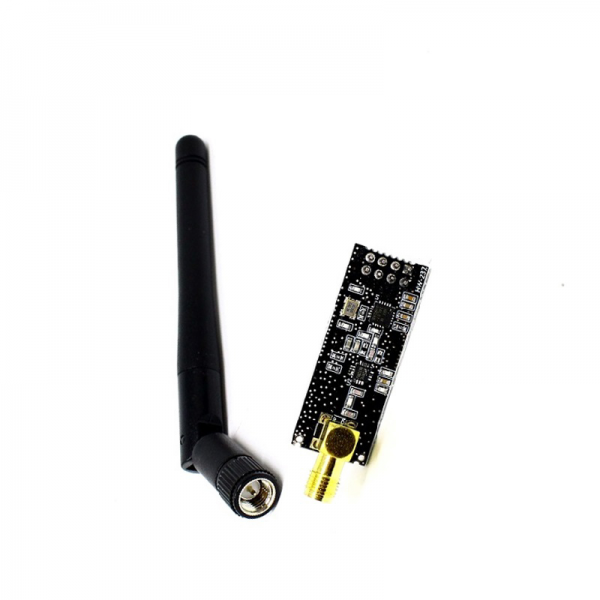
Arduino and Raspberry Pi compatible wireless 2.4GHz transceiver
Includes 2.4GHz 2.2dBi duck antenna
Signal PA (Power Amplifier) and LNA (Low-Noise Amplifier) extends the range of this module considerably
Applications: wireless peripherals, remote control systems such as RC vehicles and consumer remote electronics, wireless voice transmission such as VoIP, wireless sensor networks, wireless networks, home and commercial automation
Product Contents
1 - nRF24L01+ module with PA and LNA
1 - 2.4GHz 2.2dBi Duck Antenna
Specifications
The nRF24L01+ is a 2.4GHz ISM band transceiver
Range: 800+ meters line of sight (refer to Important Note section below)
Includes on board support components and the RFX2401C which is the PA (Power Amplifier) and LNA (Low-Noise Amplifier)
A host microcontroller can communicate and configure the nRF24L01+ over a 4-pin Serial Peripheral Interface (SPI). The configuration registers are accessible through the SPI connection. Configurable parameters include frequency channel (125 selectable channels), output power, and data rate (data rates: 250kbps, 1Mbps, and 2Mbps).
The on-chip voltage regulator accepts supply voltages from 1.9 to 3.6V.
The module has 5V tolerant inputs which allows for direct connection of SPI pins to the Arduino.
Internal filtering results in high margins of meeting RF regulatory standards. The module's radio uses Gaussian Frequency-Shift Keying (GFSK) modulation as well as fast
Automatic Gain Control (AGC).
The module includes an Interrupt Request (IRQ) pin which can be used to wake the host microcontroller, (ex: Arduino), from sleep when the module receives a transmission providing great power conservation in battery devices.
Auto-acknowledge and auto-retransmit abilities
Board dimensions, excluding pins: 15.5mm (0.61") width x 40.7mm (1.6") length x 12.2mm (0.48") height
Dimensions of antenna, when angled at 90 degrees: 87mm (3.43") height x 9.5mm (0.37") diameter
Important Note
To maximize the transmission/reception distance (range) we recommend the following:
Using a slower data rate, preferably 250kbps
In addition to the GND header pin we recommend also connecting your source ground to the ground through-holes or castellations near the brass antenna connector
Adding a 10uF capacitor across GND and V+ to assist with power demands during transmitting and receiving
Using a dedicated 3.3V power source instead of an Arduino's 3.3V supply, a good 3.3V regulator such as the LD33V works well
The module will work without the above recommendations but following the above recommendations will increase the module's total range